Our Value Creation Model
The NSHD Group’s value creation is built on the high scalability of industrial gases and is driven by the mutually reinforcing cycle of three sources: foundational technologies cultivated in the industrial gas business, a proactive spirit (innovative mind), and a culture of Operational Excellence. By combining these inherent strengths with an accurate understanding of customer needs gained through ongoing dialogue with customers and timely responses to those needs, NSHD is able to continuously create new value.
Medium-Term Management Plan (MTP) Next Innovation 2030
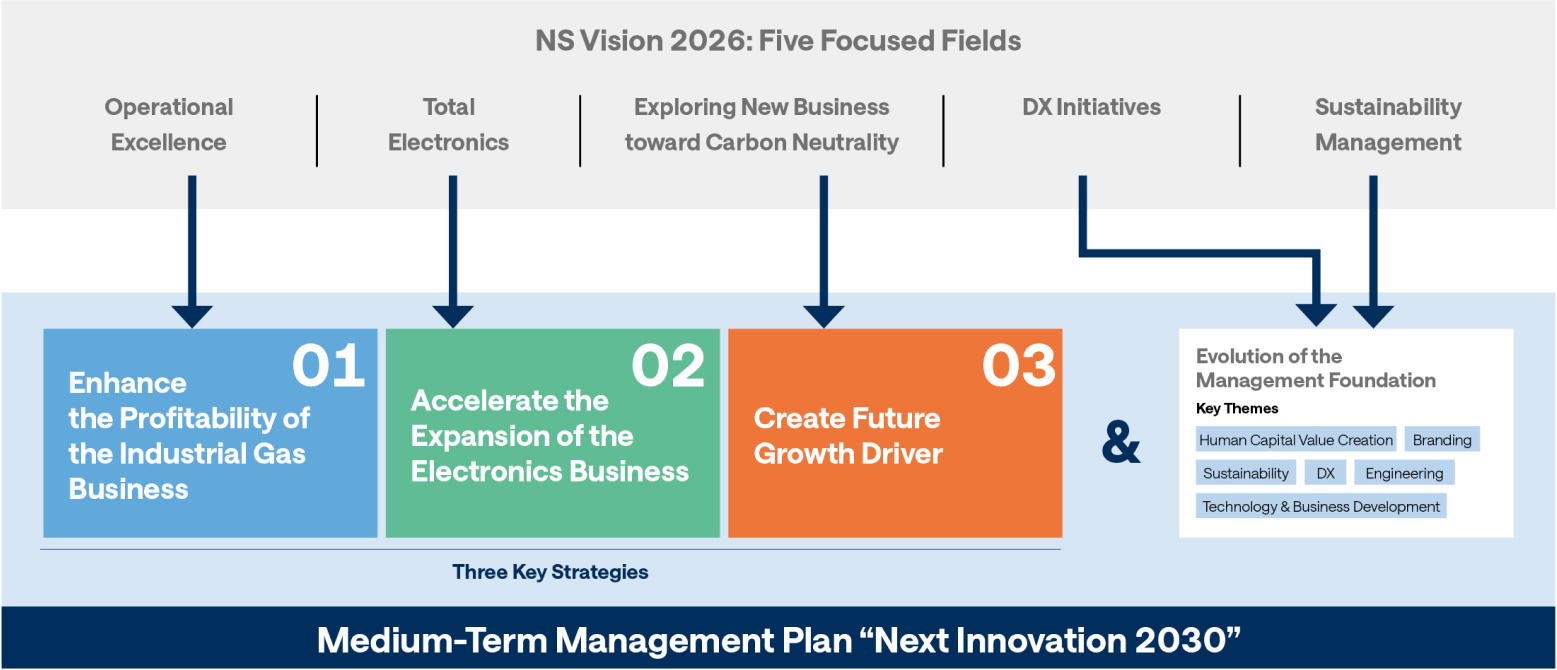
Nippon Sanso Holdings has formulated a new MTP, Next Innovation 2030, covering the period from FYE2027 to FYE2030. The Company has set both financial and sustainability key performance indicators (KPIs), and has also announced the details of its activities for achieving them. Under Next Innovation 2030, we will further enhance our innovative mind and technological capabilities, which are the sources of the Group’s value, as we aim to evolve into a company that responds accurately to environmental changes and addresses future challenges. We have identified enhancing the profitability of the industrial gas business, accelerating the expansion of the electronics business, and creating future growth drivers as our key strategies, and will work to steadily expand business earnings and create new growth drivers. At the same time, we will focus on evolving our management foundation through human capital value creation, branding activities that enhance corporate value, strengthening technological development capabilities, engaging in sustainability efforts that respond to stakeholder expectations, and promoting digital transformation (DX) to generate new value.
Our Road Map
2026
Our External Environment
The main features of our external environment are climate impact, economic uncertainty, geopolitical instability, development of a digital society, and diversification of thinking and lifestyles.
We are under pressure to respond to these changes. In particular, it is important to closely monitor rising geopolitical risks and the opportunities and risks created by digital technologies.
Priority Social Issues
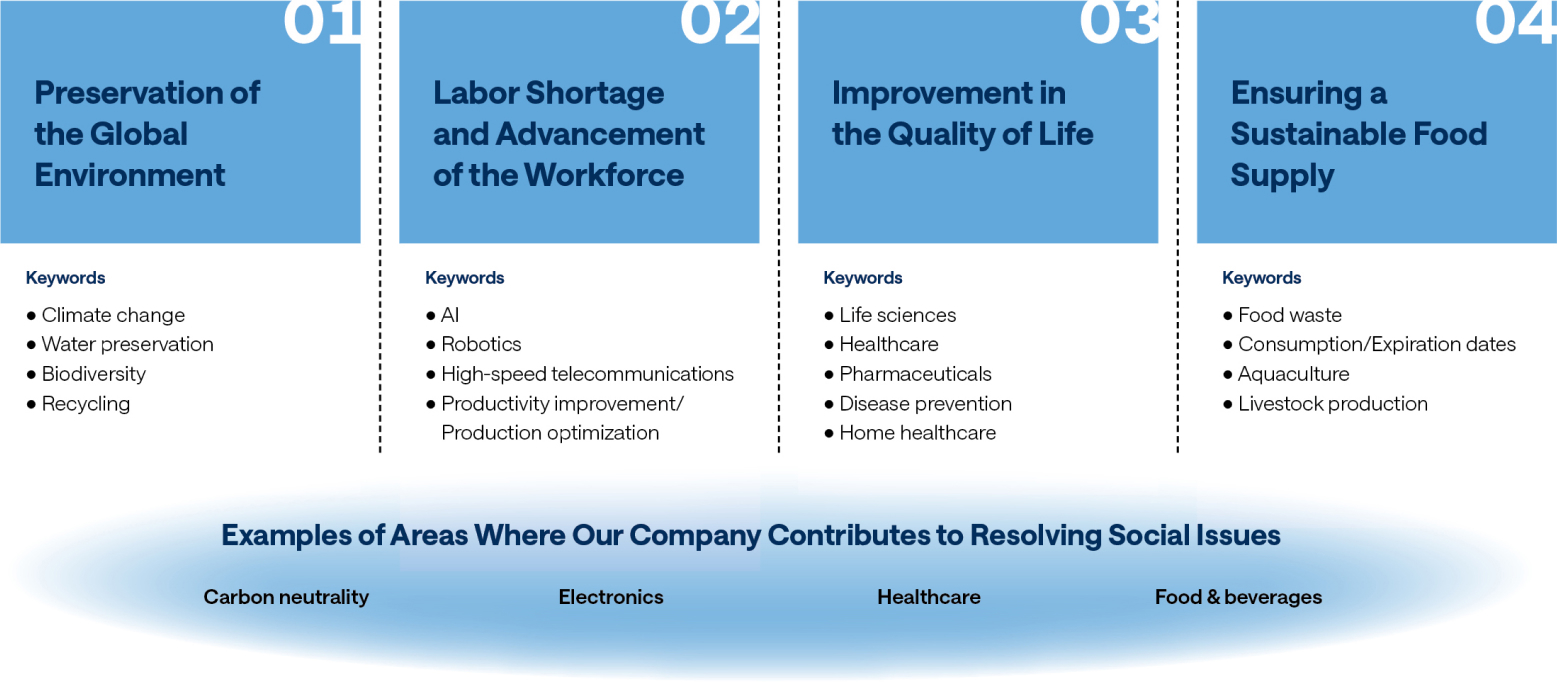
The NSHD Group has identified the following social issues to focus on addressing: preservation of the global environment, labor shortages and advancement of the workforce, improvement in quality of life (QOL), and ensuring a sustainable food supply. These are fundamental issues facing society, including changes in industrial structures, demographic shifts, and resource constraints, and they are also areas where the NSHD Group’s technologies and business domains can contribute. By providing solutions to each of these issues through our broad business domains, including carbon neutrality, electronics, healthcare, and food and beverages, we will continue to create both social value and corporate value in a sustainable manner.
2030
MTP Next Innovation 2030,
Ending in FYE2030
Aiming to evolve into a company able to respond effectively to environmental changes and address the challenges of the future
Financial KPIs
Profitability
| Revenue |
¥1,500–1,575 billion |
| Core operating income |
¥250–275 billion |
| Core operating income margin |
≥17% |
| EBITDA |
¥400–440 billion |
| EBITDA margin |
Consolidated: ≥26.5%
(By segment: ≥19.0%) |
Financial Soundness
| Net debt to EBITDA ratio |
≤1.5 |
Capital Efficiency
(Assumed new MTP exchange rates: USD/JPY 150, EUR/JPY 175)
Sustainability KPIs
Environment
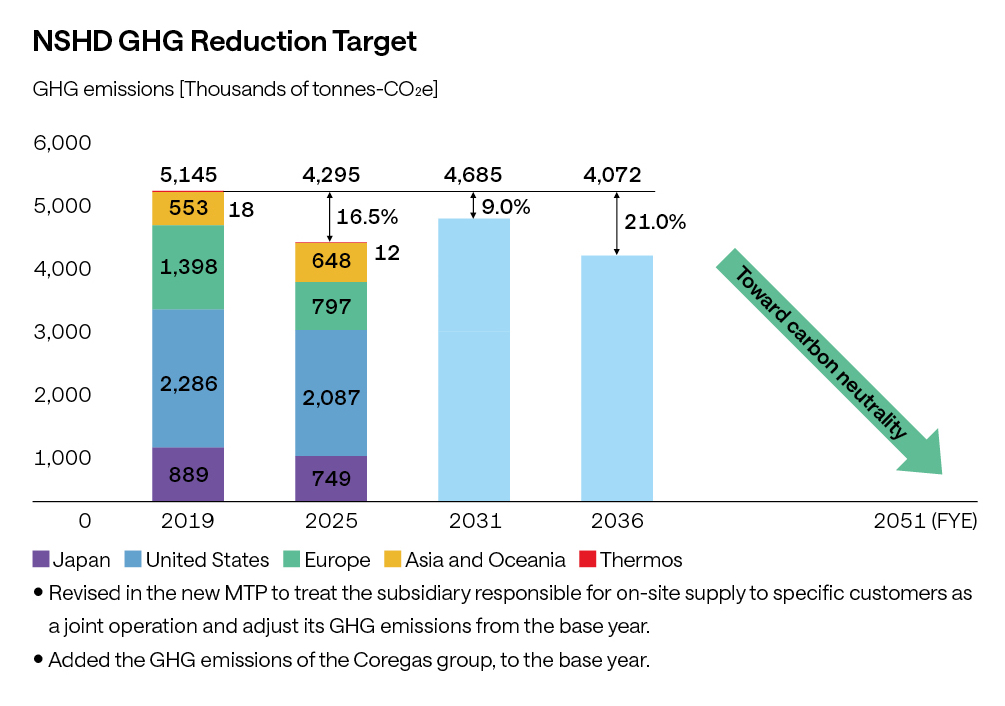
| Greenhouse gas (GHG) emissions reduction rate |
9% (FYE2031), 21% (FYE2036)
* (Reference) 32% (FYE2031), 42% (FYE2036)
[before changes in the scope of consolidated subsidiaries and before reflecting the Asia hydrogen business] |
| Increase in GHG reduction contribution from environmentally contributing products and services |
30% |
| Increase in revenue from sustainable businesses |
30% |
| Reduction in water withdrawal per unit of production |
10% |
| Reduction in waste per unit of production |
10% |
Safety
| Lost time injury rate |
≦1.3 |
Human Resources
| Ratio of female management posts |
≥22% (FYE2031) |
| Ratio of female employees |
≥25% (FYE2031) |
| Sustainable engagement score |
≥83 |
Compliance
| Compliance Survey Score |
≥80 |
2050
We Aim for Carbon Neutrality
by 2050 Through Technological Breakthroughs.
Pathway to Carbon Neutrality by 2050
NSHD GHG Reduction Target
Measures of Our Group
- Further promotion of energy conservation and efficiency of energy use
- Promotion of the use of renewable energy and green power
- Carbon capture and offsets