Basic Approach
Nippon Sanso Holdings' Board of Directors has formulated the Principles of Corporate Governance, which provide
guidance on corporate governance. Realizing the Company's
sustainable growth and long-term increase in corporate value, and benefiting all stakeholders, including shareholders,
customers, employees, suppliers, and local communities, involves ensuring the fairness and transparency of
decision-making. Moreover, we are working to enhance corporate governance, believing that its essence lies in making
effective use of our management resources, and to increase the vitality of management through swift and conclusive
decision-making.
History of Changes in NSHD’s Corporate Governance
2015–2019: Governance structure transformation
2015
| June |
Appointed two independent outside directors (two of eleven directors) |
| October |
Established the Principles of Corporate Governance and Disclosure Policy (now IR Policy) |
2016
| June |
Established Advisory Committee on Appointments and Remuneration
Introduced performance-linked remuneration for directors |
2019
| June |
Appointed two directors of foreign nationality (heads of U.S. and European businesses) |
2020–2023: Establishment of a transparent governance framework
2020
| October |
Transitioned to a holding company structure |
2021
| June |
Increased independent outside directors to three (three of nine directors; one female outside director) |
2022
| June |
Increased independent outside directors to five (five of nine directors; two female outside directors)
Introduced non-financial KPIs linked to remuneration of directors |
From 2024: Ongoing revisions
2024
| June |
Revised remuneration for directors (added KPIs for non-financial KPI-linked remunerations for directors, etc.) |
Evaluation of the Board of Directors' Effectiveness
Our Principles of Corporate Governance stipulate that the Board of Directors carry out an annual analysis and
evaluation of its overall effectiveness based on self-evaluations by each director, and make a summary of the results
public in a timely and appropriate manner. The Board of Directors continues to conduct analyses and evaluations of its
effectiveness and make constant efforts to enhance it. Based on the overview and results of the Board of Directors'
effectiveness
evaluation for FYE2026, the Board conducted the following main initiatives in FYE2027.
Corporate Governance Structure
Nippon Sanso Holdings' governance is characterized by rapid decision-making and appropriate allocation of management resources. This is achieved by delegating authority to the operating companies in each of the four geographic hubs and the Thermos business, which support an industrial gases business model that produces gases on the site of consumption. As a group that has global business operations, supervision of management decisions and business execution requires a multifaceted valuation of a wide range of risks based on expert knowledge informed by close contact with the front lines.
The Company has adopted the organization of a company with Audit & Supervisory Board, and has a Board of Directors comprising internal directors with a thorough knowledge of the Company’s business and independent outside directors who have diverse skills and experience. The Board of Directors discusses management strategy, capital expenditure, M&As, and so forth, makes decisions on the Company’s business execution, and supervises its business execution. Moreover, Audit & Supervisory Board members, who are independent from the management organization, exercise their own authority to audit the process of decision making by directors and the status of management execution.
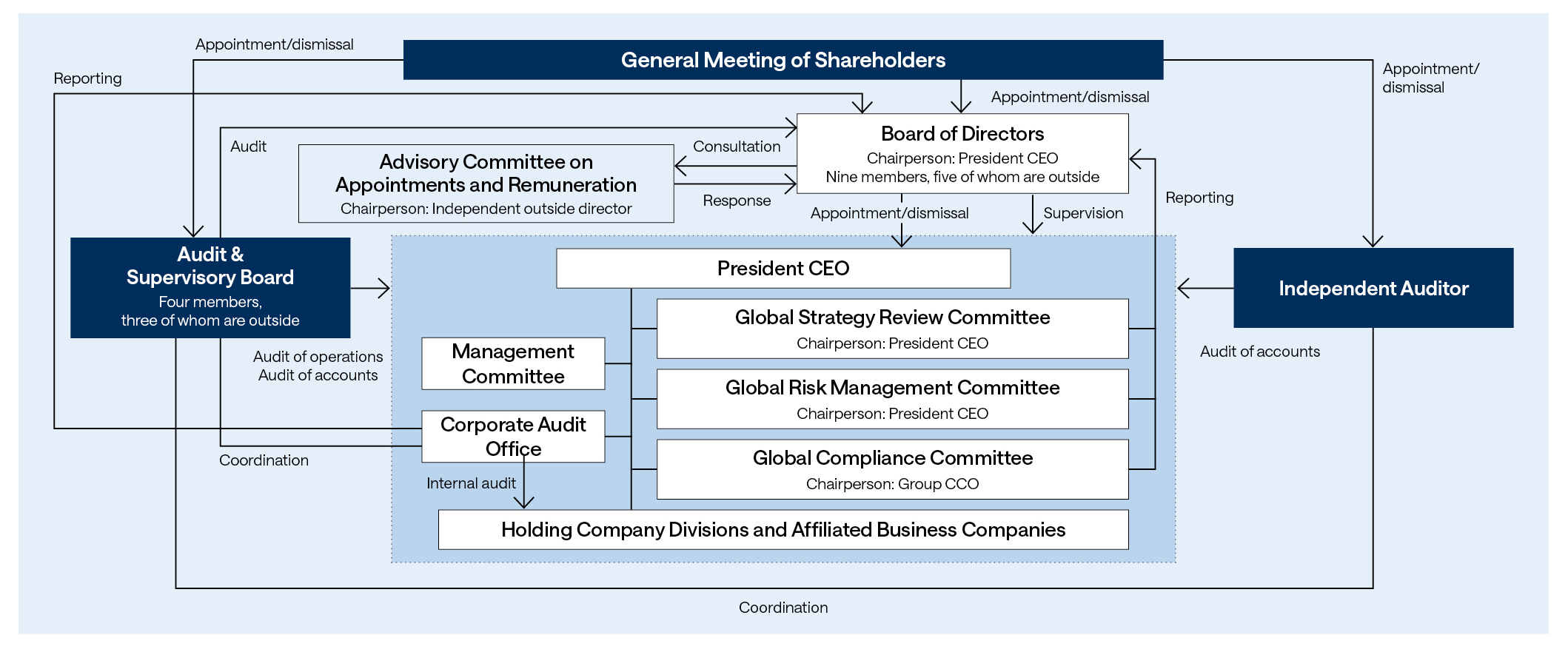
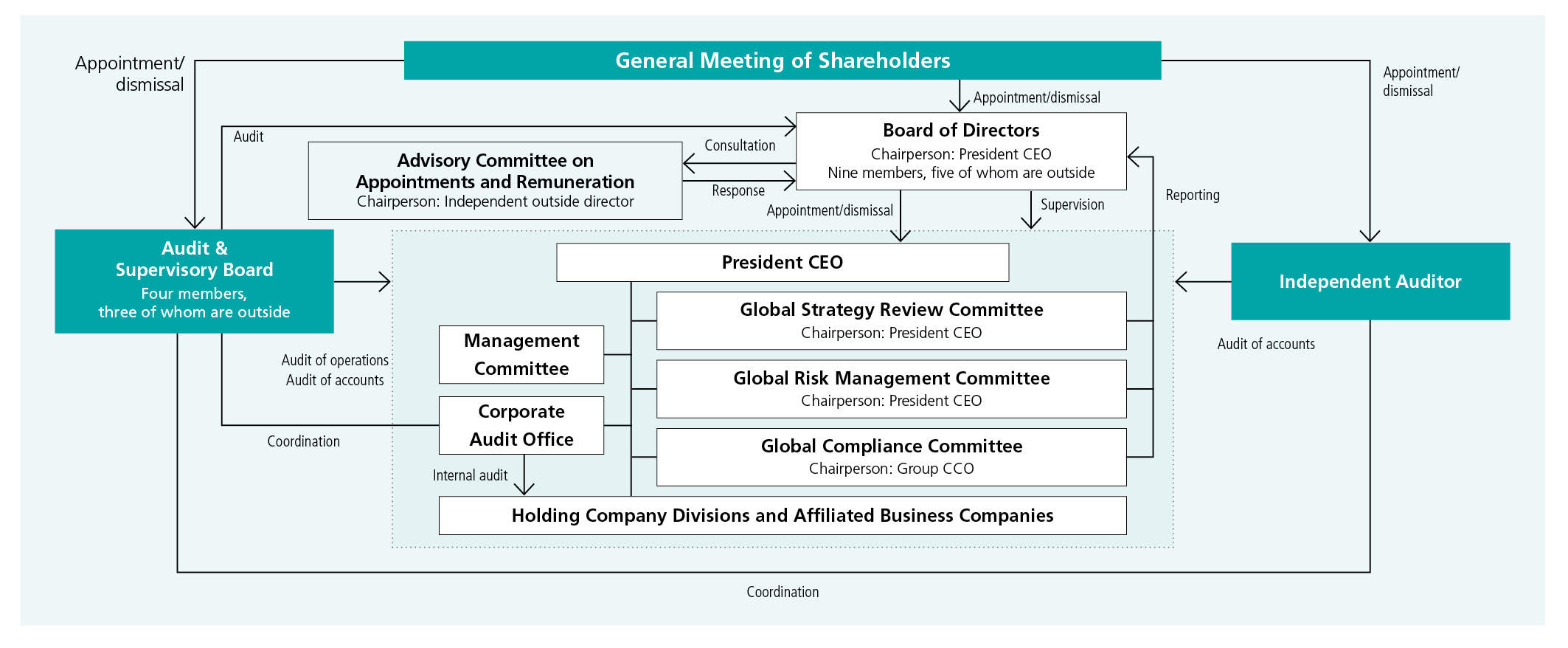
Committee
| Committee |
Overview |
| Board of Directors |
Chairperson: President CEO
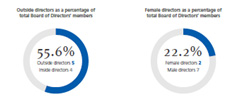
Composition: Nine directors, with a majority of five being independent outside directors. One of the directors is non-Japanese. Two of the directors are women.
In order to enable accurate management decisions, we consider diversity in the composition of the Board of Directors in terms of skills and experience. The Board meets monthly in general to discuss important matters and receive reports on the status of NSHD’s businesses. The Board also supervises the execution of business by the President CEO.
|
| Audit & Supervisory Board(ASB) |
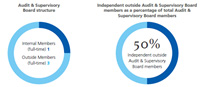
Composition: Four full-time members, including three outside members (two of whom are independent outside members)
The ASB is an independent body entrusted by the shareholders to audit the decision-making process of directors and the state of business execution by management. The board conducts its business in accordance with applicable laws, regulations, the Company’s Articles of Incorporation, and other rules. Each member of the Board engages in audit activities from a neutral and objective perspective, bringing their expertise to the audit process. The board conducts a detailed discussion of the results of its audit activities, making recommendations as necessary, and strives to ensure sound management. The Board conducts the following types of activities in accordance with audit policies and plans as determined by the board on an annual basis. (i)Attendance at important internal meetings (Board of Directors’ meetings, Management Committee meetings, etc.) (ii)Interviews with directors, executive officers, and other members of senior management. (iii)Inspection of important decision-making documents, etc. (ⅳ) Audits of Japanese and overseas group companies. The Board strives to improve the effectiveness of audits through close coordination with the Company’s internal audit division, internal control division, and accounting auditor. The board also engages in the regular exchange of information and opinions with outside directors. We have established an independent office for the Board. This office is staffed with full-time employees who assist members of the board in their duties and under their direction.
|
| Advisory Committee on Appointments and Remuneration |
Chairperson: Independent outside director
Composition: President CEO and five independent outside directors
The Committee receives requests for advice from the Board of Directors regarding the selection of candidates for directors and Audit & Supervisory Board members, appointment and dismissal of the President CEO and executive officers, selection of the successor to the President CEO, appointment and dismissal of the Chairperson and President in the significant directly owned subsidiaries and revision of internal rules regarding remuneration of directors. The Committee reports the results of its deliberations back to the Board of Directors. Since the majority of the members of the Committee are independent outside directors, it is able to ensure independence from the parent company in the appointment of management team members, thereby helping to ensure transparency and objectivity in the decision-making of the Board of Directors.
|
| Executive Management Committee |
Chairperson: President CEO
Composition: President CEO, executive officers, and members of the Audit & Supervisory Board
Based on the Group’s basic policies as determined by the Board of Directors, the Committee deliberates and makes decisions on important matters related to the execution of duties by the President CEO.
|
| Global Strategy Review Committee (In principle, once a year) |
Chairperson: President CEO
Composition: President CEO, executive officers, officers, members of the Audit & Supervisory Board and persons appointed by the Chairperson
Prior to the making of a resolution on the NSHD Group’s budgets for the next fiscal year, the Committee confirms the details of each operating company’s strategy and deliberates on the optimal allocation of resources across the entire Group. It also formulates the Group’s management strategy and manages its progress. Among items determined by the Committee, specific measures for technical risks are decided at Technological Risk Liaison Committee meetings and other meetings held between NSHD and each operating company, then deployed globally.
|
| Global Risk Management Committee (In principle, once a year) |
Chairperson: President CEO
Composition: President CEO, members of the Audit & Supervisory Board, Group CCO, executive officers, officers, the persons who are responsible for the regional risk management (operating company presidents etc.), and persons appointed by the Chairperson
The Committee deliberates on the selection of the Group’s material risks, matters related to countermeasures, basic policy on risk management for all Group companies, and matters related to regulations and plans.
* CCO: Chief Compliance Officer
|
| Global Compliance Committee (In principle, once a year) |
Chairperson: Group CCO*
Composition: Regional CCO* (Japan, the United States, Europe, East Asia, Taiwan, Southeast Asia and India, Australia, and Thermos)
The Committee is convened in principle by the Group CCO to ensure the effectiveness of the Group’s compliance. At the meetings, the Compliance Promotion Policy and compliance promotion activities in each area are shared, and individual issues are discussed as necessary.
* CCO: Chief Compliance Officer
|
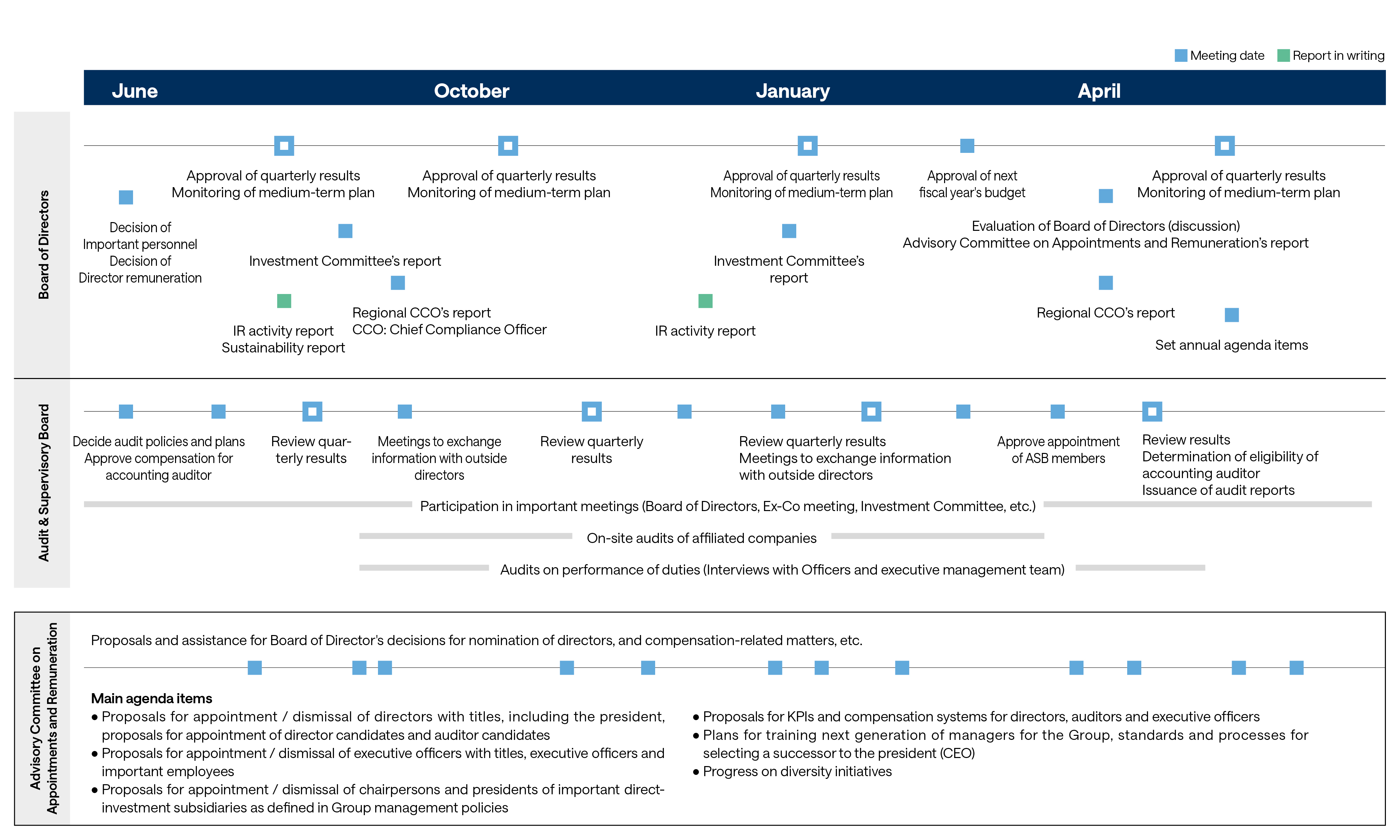
Yearly schedule
Relationship with the Parent Company
We, having Mitsubishi Chemical Group Corporation (MCG) as our parent company, belong to a corporate group led by MCG (MCG Group). The MCG Group’s business is composed of Specialty Materials, MMA & Derivatives, Basic Materials, and Industrial Gases. We are positioned as an entity in the industrial gases segment. Being the only one operating industrial gasses business in the MCG Group, we do not compete with other companies in the MCG Group, and as of this moment do not expect to do so in the future.
We concluded a basic agreement with MCG on May 13, 2014. The basic agreement stipulates that the MCG, under its Group Management Regulations, respects our autonomy and is committed to supporting and cooperating with us. Accordingly, we make our own business decisions and do not require MCG’s approval for any matters. The basic agreement also includes provisions on maintaining the Company’s stock listing.
We have appointed five independent outside directors, who constitute a majority in the nine members of board, and two elected full-time independent outside Audit & Supervisory Board members. With this structure, even in cases where there is a risk that the interests of the parent company and those of our other shareholders may conflict, we appropriately handle it to ensure that the interests of shareholders other than the parent company and not unfairly compromised.
Furthermore, we have voluntarily established the Advisory Committee on Appointments and Remuneration* that advises the Board of Directors on the nomination of candidates for directors and Audit & Supervisory Board members, as well as the appointment and dismissal of the CEO and other executive officers. The committee is composed of six members—the president and five independent outside directors—and is chaired by an independent outside director. This ensures our independence from the parent company on management appointments.
*This is a voluntary committee of the Company that advises the Board of directors on selection of candidates for directors and Audit & Supervisory Board members as well as the appointment and dismissal of the Representative Director, President CEO and other executive officers.
Appointment of corporate officers
We believe that for the Board of Directors to function effectively it must consist of a diverse team of directors who
have a broad range of knowledge and experience in corporate management. Therefore, we have defined the knowledge and
experience that play an important role in the management of our group and summarized them in the following skill
matrix. We will strive to further enhance the effectiveness of the Board of Directors while placing personnel with
these knowledge and experience in the right places at the right time. The Board of Directors requests the Advisory
Committee on Appointments and Remuneration for advice on the selection of candidates for director, and the committee
creates a list of candidates after giving consideration to the composition of the Board of Directors, the qualities
required of directors, and, for those who are to assume important responsibilities, their activities and achievements
as director to date. The list is submitted as a proposal to the Board of Directors. In addition, we have established
criteria for determining the independence of outside directors and corporate auditors, and selects as candidates for
directors and corporate auditors those who meet such criteria.
Remuneration for Officers
The total amount of remunerations for directors and Audit & Supervisory Board members was approved, respectively, at the General Meeting of Shareholders. The specific amount of remuneration for each director is determined by the President CEO, who is authorized by the Board of Directors, based on a remuneration standard approved by the Board. The amount of remuneration for each Audit & Supervisory Board member is decided through internal discussions among the members of the Audit & Supervisory Board. We have established the Advisory Committee on Appointments and Remuneration, which comprises multiple independent outside directors and the President CEO, and is chaired by an outside director. The committee deliberates the appropriateness of proposed remuneration after being consulted by the Board of Directors and the Audit & Supervisory Board, and then reports its findings to both boards. Directors’ remuneration comprises several components: base remuneration, annual bonuses as short-term incentives, and stock-based remuneration as a medium- to long-term incentive (for non-residents of Japan, cash remuneration equivalent to stock-based remuneration).
In the latest revisions, we introduced a performance-linked stock-based remuneration plan for directors to further clarify the linkage between directors’ remuneration and the Company’s performance and share value, and to enhance directors’ awareness of contributing to the improvement of medium- to long-term performance and corporate value by sharing with shareholders not only the benefits of share price increases but also the risks associated with share price declines.
Outside directors receive only base remuneration as fixed compensation from the Company. Remuneration for Audit & Supervisory Board members, including outside members, consists solely of fixed compensation.
Succession planning
Developing the Next Generation of Leaders
Within the NSHD Group’s governance structure, we place significant emphasis on preparing the next generation of leaders. The Advisory Committee on Appointments and Remuneration, comprising several independent outside directors and the President CEO, while chaired by an outside director, constantly deliberates on the qualifications required of next-generation leaders, the selection process, training policy, and candidate identification. NSHD is implementing concrete initiatives for the development and evaluation of management candidates, based on the view that next-generation leaders must possess high ethical standards and integrity, extensive experience in the industrial gas business, a global perspective, strong leadership, execution capability, strategic thinking, and communication skills. Given our Group’s presence in over 30 countries and regions worldwide, we are committed to developing human resources with deep expertise in our distinctive industrial gases business model, which focuses on production at the site of consumption, comprehensive understanding of the industry structure in each region, and the ability to manage operations with a global perspective.
Training for Top Management
To accelerate global business development, NSHD has established a training system designed to enhance the capabilities of senior management. This system aims to refine the decision-making abilities of our leaders by equipping them with diverse perspectives and knowledge expected at the highest levels of leadership. Below is an overview of the training programs we have implemented over the past three years.
- April 2023 Prevent corruption globally
- January 2024 Business and human rights
- August 2024 Risk management by teaching officers about recent misconduct cases
- February 2025 Global data governance and points to remember when using generative AI
- August 2025 Risk Management and Practical Responses in Overseas Business Operations
- January 2026 Key Issues in Compliance
Eligible participants include directors, Audit & Supervisory Board
members, and executive officers of NSHD and Nippon Sanso Corporation.
We will continue to deliver timely training initiatives to further elevate the caliber of the Company’s management team.
Status of Compliance with the Corporate Governance Code
In addition, we have submitted a "Corporate Governance Report", describing the status of our corporate governance
corporate governance measures to the Tokyo Stock Exchange as follows.
(The document below is submitted on June 18, 2026.)
System to Ensure the Appropriateness of Business Operations (Internal Control System)
The system to ensure the appropriateness of business (“internal control system”) specified by the Companies Act and the Regulations for Enforcement of the Companies Act, is determined by a resolution adopted at the Board of Directors, as follows.